
Jewelry, Watches, and Accessories: Custom Storage That Actually Protects What You Own
Plenty of closets get planned down to the inch. Double hanging for shirts, long hanging for dresses, shelves spaced for folded sweaters. Then the jewelry ends up in a dish on the dresser, the watches live next to the car keys, and the belts get rolled into whatever drawer has room.
Most closet advice follows the same pattern. Clothing gets the attention, and accessories get a line about “small organizers” near the end. Rings, chains, and watches are the items most likely to scratch, tangle, or tarnish when they’re stored badly, and many of them cost more than anything on the hanging rods.
Below, we cover why generic organizers fall short, what works for each type of accessory, and how storage affects wear over time.
Why Generic Drawer Organizers Fall Short
The plastic inserts sold at big-box stores are built for a standard drawer that rarely matches the one in your closet. Drop one into a custom drawer and you’ll get a gap on one side, or a tray that slides forward every time the drawer closes.
Depth causes the next set of problems. A typical clothing drawer is deep enough for jeans and sweaters, so jewelry ends up stacked in layers. Chains knot together, a ring at the bottom picks up scratches from the bracelet on top of it, and finding one specific pair of earrings means digging.
Then there’s the material. Hard plastic gives metal and stones nothing soft to rest against, so every open and close knocks pieces into each other.
Most of this happens because accessory storage gets figured out after the closet is installed, so it ends up squeezed into whatever space is left over.
Closet Jewelry Storage by Accessory Type
Rings, watches, and belts each need something different, so a good closet jewelry storage plan handles them separately.
Jewelry: Shallow Drawers and Lined Trays
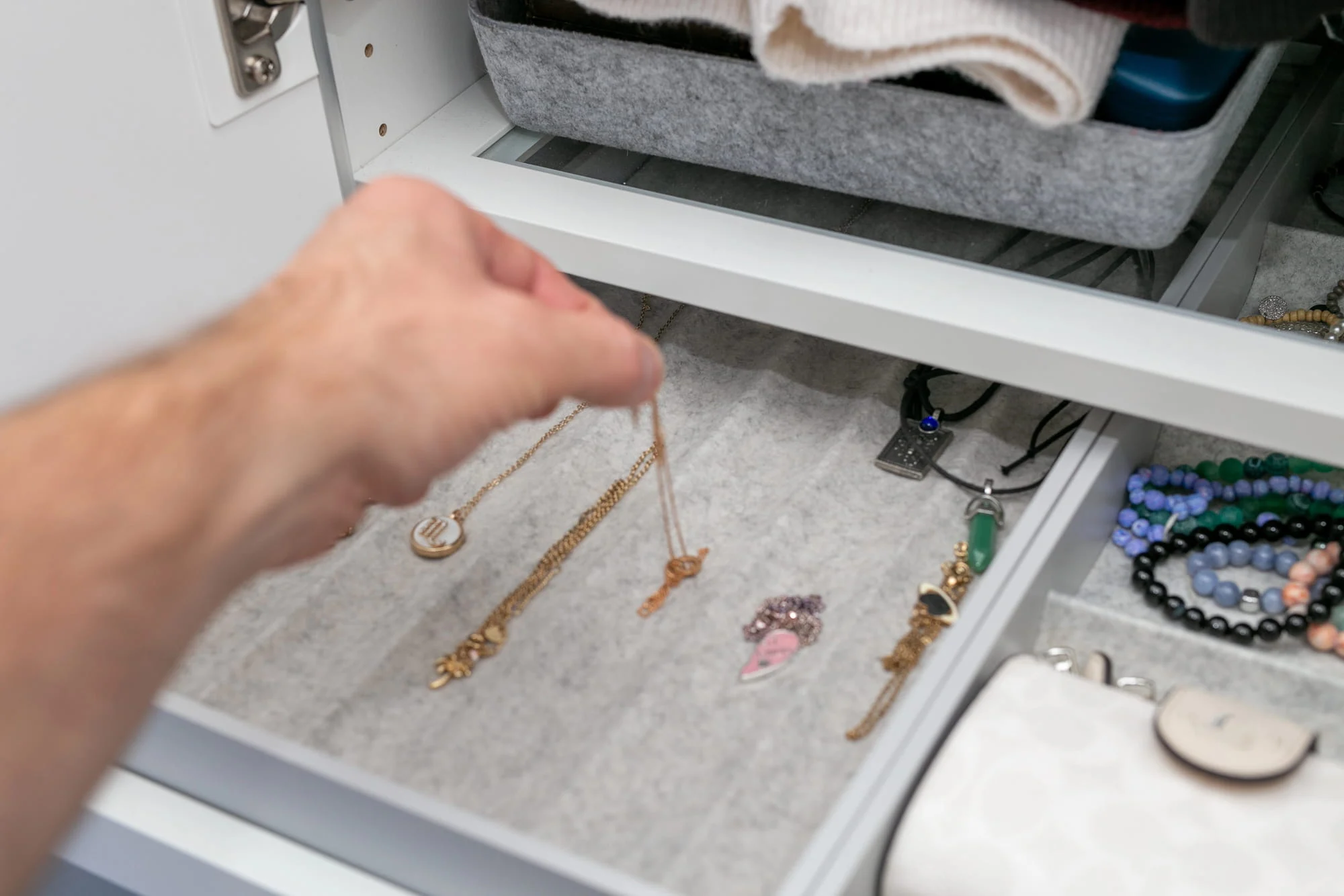
The most useful change for jewelry is a shallow drawer. When a drawer is only a couple of inches tall, everything sits in one layer and you can see the whole collection the moment you pull it open.
Inside that drawer, felt- or velvet-lined trays do most of the work. Fitted compartments keep rings, earrings, and bracelets apart, and the soft lining keeps metal from rubbing against hard surfaces. A few layouts worth planning for:
- Ring rows or slotted inserts that hold rings upright and visible
- Small square compartments for earrings, sized so pairs stay together
- Long, narrow channels for necklaces, so chains lie flat and stay untangled
- Stacking trays that double the storage in a single drawer
Because we can source products from vendors nationwide, lined inserts can be matched to the exact drawer size and the pieces going into it.
Watches: Cushioned and Visible
Watches need protection for the face and crystal, and they’re easier to wear in rotation when you can see the whole collection at once.
Lined watch trays with individual pillows or slots handle both. Each watch wraps around its own cushion, faces never touch, and bands hold their shape. Putting that drawer near the spot where you get dressed makes choosing a watch part of the morning routine.
If you own an automatic watch winder, mention it during design so we can plan for its depth and access to power.
Belts, Ties, Scarves, and Everything Else
The rest of the accessory collection is where storage tends to fall apart. A few approaches that hold up:
- Belts can be rolled into divided drawer sections or hung if the collection is large
- Ties stay crease-free when they’re rolled in shallow compartments or hung flat
- Scarves fold neatly into divided drawers or hang loosely so delicate fabrics don’t crush
- Sunglasses get their own slots, which keeps lenses from getting scratched
Building Accessory Storage Into the Larger Closet Design
Accessory storage works best when it’s part of the closet from the first sketch. In walk-in closets, islands and peninsulas are the natural home for it. The top drawers sit at a comfortable height, they’re in the middle of the room where you get dressed, and they keep jewelry, watches, and sunglasses within arm’s reach.
For pieces you want on display, glass framed doors keep a collection visible while protecting it from dust.
Matching finishes matter too. With molded drawer fronts at no extra charge and over 1,000 hardware options, accessory drawers can look like they belong with the rest of the system.
That planning happens during the 3D design stage, which is why we ask about accessories at the consultation. Knowing you own 30 watches or a large scarf collection changes how many shallow drawers we plan and where they go.
How Proper Storage Prevents Tarnish and Damage
Silver tarnishes when it reacts with sulfur compounds in the air, and humidity speeds that up, so Maryland summers don’t do your jewelry any favors. A sterling bracelet left out on an open tray will darken faster than one tucked away in a closed drawer.
Separate compartments protect against scratching. Diamonds and other hard stones can scratch gold, silver, and softer gemstones when pieces rub together.
A few habits make any storage setup work better:
- Make sure pieces are completely dry before putting them away
- Store silver apart from other metals
- Add anti-tarnish strips to drawers that hold silver
- Return each piece to the same spot so nothing ends up loose
Give Your Accessories the Same Attention as Your Wardrobe
If you’re planning a new closet, bring a rough count of your jewelry, watches, and other accessories to the consultation. The easiest time to build storage around them is during design, before the first shelf goes in.
Schedule a Free Appointment With Chesapeake Closets
Locally owned and operated since 1987, Chesapeake Closets designs and builds custom storage solutions for homeowners throughout the Baltimore, Columbia, and Annapolis areas.
Every project starts with a free consultation and a 3D design created specifically for your space. We handle the design, the fabrication, and the installation, and everything we do comes with a lifetime warranty.
If you’re ready to add some accessory storage to your space, we can help you figure out a set up that works best for your home.
Schedule your free appointment at chesapeakeclosets.com, or call us directly:
- Baltimore: 410-823-7342
- Annapolis: 410-269-0300
- Columbia: 410-730-9287
You can also reach us by email at office@chesapeakeclosets.com.
Follow Chesapeake Closets on Facebook, Instagram, and X for project photos and design ideas.